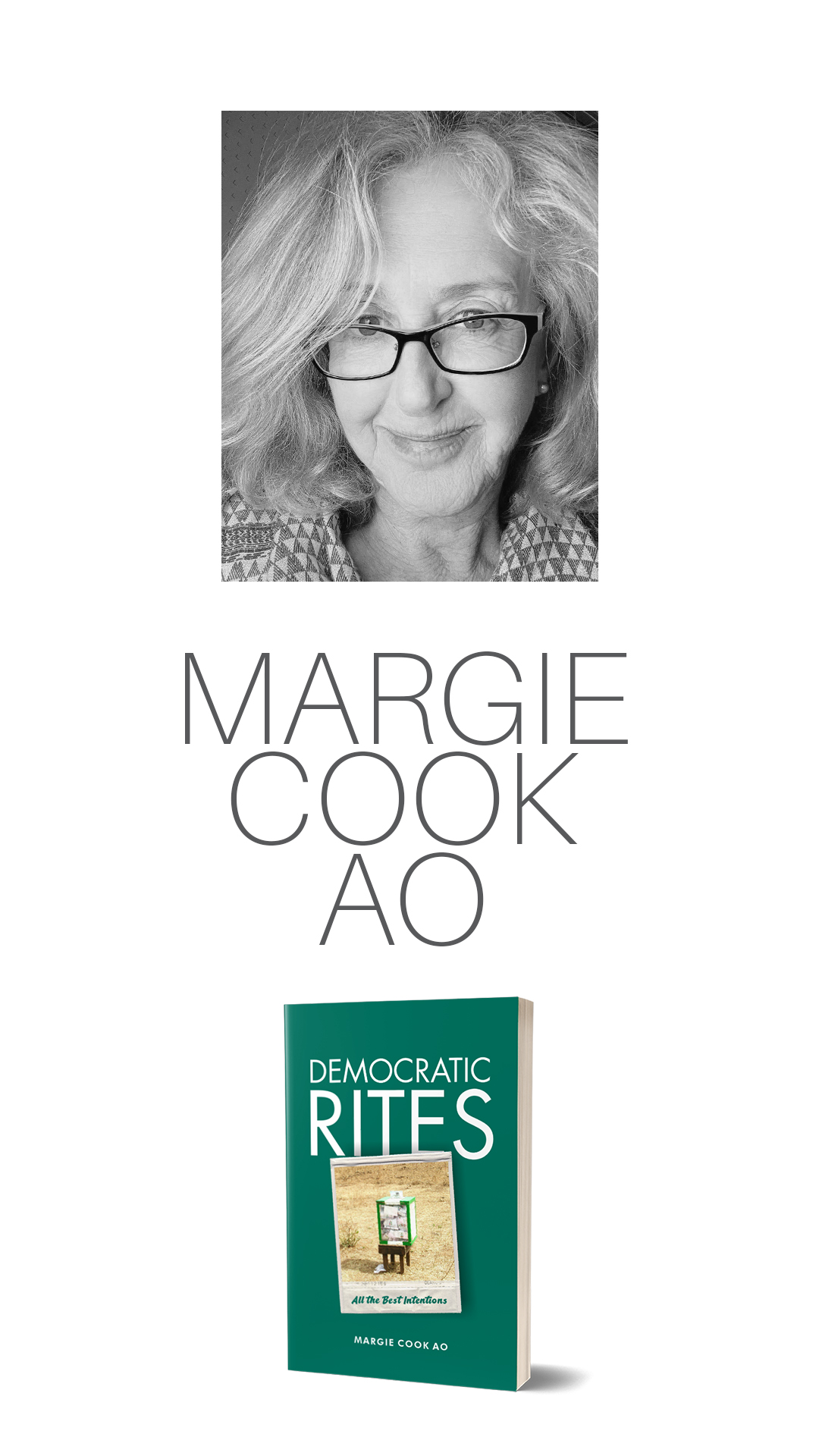
Democratic Rites: All the Best Intentions
About
“This is Emergency Sex – for grown-ups.”
The book
In October 2009 five UN staff were killed in Kabul when their guesthouse was attacked at dawn and burned down. The election was called off and Karzai declared the winner.
This followed an election in Kenya where more than a thousand people died.
Despite all the best intentions, both were bloody and ignominious ends to thoroughly flawed processes.
Tracing her personal journey in elections from Nigeria to Tanzania, Kenya to Afghanistan and Zimbabwe, this first-hand, behind-the scenes account of UN and internationally-sponsored elections paints a picture of increasing institutional dysfunction, betrayed staff and shattered dreams with the occasional blinding good example shining through.
Democratic Rites is crammed with extraordinary scandals, institutional flaws, blind-eyes turned and hair-raising adventures. It’s a window to the billion-dollar world of international development: at once well-intentioned, bureaucratically kafkaesque, horrifyingly dangerous and darkly bizarre.
It is an increasingly tense, explosive and personally costly tale of shambolic, often inept, racist and broken leadership, the struggles faced in helping to run multi-million-dollar elections in some of the world’s toughest places and the corporate blindness of the UN to life-threatening situations.
Democratic Rites: All the Best Intentions not only recounts a personal journey but forensically picks apart processes that could – and should – have been different. There are compelling reasons why such work should continue. As one of the writer’s staff in Afghanistan said: “I am proud that I am working for bringing bright future of my country in spite of high risk.’”
That dream failed. This book argues why that dream should not be forfeited and for a continued commitment to the promotion of democratic processes for the sake of those whose hopes and futures depend on it.
This book tells my story and those of many others who have worked in democratic development in many in the harshest if places. – often while the UN and the international community looked away.
We all remember Emergency Sex. As one publisher commented: This is Emergency Sex – for grownups.
The author: Margie Cook AO
Margie Cook is an eminently qualified author. She has spent the last twenty three years in the world’s toughest trouble spots working, as one of the few women in such positions, in senior leadership roles for the UN and donors including the UK and US on projects supporting elections, human rights and development. She was UN’s Chief Electoral Adviser in Afghanistan from 2008-10, which saw the election cancelled after her staff were murdered in a targeted terrorist attack. Her criticism of the UN in Afghanistan led to a long-term but un-stated black-listing.
After nearly eleven years with the UN, working across Nigeria, Tanzania, Cambodia, Kenya and Afghanistan, Margie joined a UK/US private development advisory firm and spent the next decade in in Kenya and Zimbabwe. She has advised the UN and donor entities including the FCDO in Malawi, Ethiopia, Iraq, Yemen, Rwanda, Sierra Leone, Fiji, Zambia, Jordan, Nepal, and elsewhere. Her current role in Pakistan is supported by the EU.
Before joining the UN Margie was the Director of Public Affairs in the Australian Human Rights Commission. The wildly successful media strategies for major inquiries including those on Mental Illness and The Stolen Children were her work. She is the co-author, with barrister Dr Robert Cavanagh, of Maralinga, a dramatised documentary about the nuclear weapons testing program in Australia which was directed, for its inaugural performance, by Baz Luhrmann. She previously ran her own Public Affairs business with major clients being AusAID, World Vision and the Human Rights Commission. She travelled extensively writing stories for Australian newspapers and current affairs television.
She has worked with the National Nine Network in Australia providing electoral expertise for every state and federal election since 1987.
Margie was awarded an AO (Officer in the Order of Australia) in the Australia Day honours in January 2019 for services to the international community in the promotion of democracy and human rights.
Margie is a founder member of The Platinum Partnership, a consultancy collective of global senior electoral and governance experts.
Why?
What are democratic rites?
Preface
In the silence of the pre-dawn of 28 October 2009, a white government plated vehicle filled with heavily armed men dressed in Afghan police uniforms, some wearing suicide vests strapped to their bodies, snaked its way through the rings of steel supposedly protecting central Kabul. It was a week before the bitterly challenged run-off to the presidential elections. Hamid Karzai had been hailed the winner by the government-appointed Electoral Commission, but a UN-sponsored review and audit of ballot boxes found otherwise. Karzai had been forced, humiliatingly, to agree to a negotiated result putting him behind the minimum fifty per cent plus one needed for a confirmed win and persuaded to agree to a run-off with his contender, Abdullah Abdullah. Ashraf Ghani had run a miserably poor third. Karzai was livid. At around ten to six in the morning a bomb blew open the gate of the Bakhtar guesthouse where many of the UN’s election staff resided.
My staff
Across Kenya, the killings started.
The violence had been totally predictable since at least the August prior, but the local UNDP[1] leadership turned a deaf ear and the Commission called me a panic merchant when I said a tight election was on its way. ‘You don’t understand, Margie. We’ve never had a close election’ was the refrain. Weeks later, perched on a swinging seat in his leafy garden, a suddenly aged Samuel Kivuitu told me his shocking version of events that ensured the falsification of results.
An inquiry led by international legal experts was established. I spent days giving my evidence. The inquiry failed to find core fault.
A second, Kenyan-led inquiry was more incisive. But charges laid against alleged perpetrators by the International Criminal Court were eventually withdrawn due, in part, to the ‘unavailability of witnesses’ with two of the biggest men involved both going on to Presidential terms.
Again, the town turned the other way.
I’ve been working in this environment of international assistance to elections and development in post-dictatorial, colonial and crisis countries for over twenty years. A tiny molecule in a huge, gig economy, where field workers (those on the ground, rather than in the comfy, capital-based head offices) are predominantly contractors and effectively outside institutional protection be it the UN or private sector, whose head offices are filled by snappily-dressed permanent staff housed in comfortable offices. In the UN especially, sexism, racism and nepotism flourished unchecked as experiences in Kenya and Afghanistan were to prove.
Elections carry the burden of unequalled expectations. Many are done very well. Those less glorious, but nonetheless representing positive steps in the right direction are often dispiritingly pilloried as failures. Despite dossiers of recommendations for future improvement, my experience also shows that a regime (or even an individual), institutionally corrupt or determined to rig an election, or abuse rights and processes will not be deterred from their path to power. Ironically, the wreckage left in the wake of disaster can even have commercial value as ingredients for the next round of support.
United Nations Development Programme
Where there are often no real winners.
In 2010, I took my concerns to the United Nations Development Programme (UNDP) Ombudsman’s Office. They openly warned me that ‘The only people to suffer from making a complaint are the complainants themselves. The UN looks after its own’.
Afterwards, I was effectively blacklisted by UNDP for allegedly providing information for a code cable I never saw that was sent by the UN Head in Afghanistan deservedly criticising UNDP institutional intransigence in Afghanistan. I’m told Helen Clark[1], the then UNDP Administrator, went ballistic.
Speaking truth to power is unwelcome and comes with a high price. Twenty plus years is a reasonable length of time in which the best and worst can present itself and in which to make a judgement about one’s own efforts. But even in my darkest moments I have never wavered on the question of why we bother with this work, or on the obligations owed to those with whom we work, who hopefully displace us as they own the positive change to which they contribute, or suffer as efforts fail and democratic backsliding gains pace. In 2021 as Afghanistan retreated from global attention back into the dark ages, this obligation became paramount. But I was unable to help a single individual.
There are too many occasions when the town – be it an individual leader, an institution or the global community – looks the other way.
But it wasn’t enough.
In Kenya, my laptop sat on the polished dining table in the simple stone house I leased on the grounds of the Nairobi Club. Outside, the equatorial wide blue sky of Kenya emerged into vastness at 6 am, turning black again twelve hours later. The sounds of the thwacking of cricket bats and the happy shouts of players coming from the oval just over the prickly hedge were interspersed with the occasional foray by men in whites rushing in to retrieve balls from the garden. Everything else was silent. I started to write. I sat there from 5 am on workdays. Up to twelve hours at a stretch on weekends, my ankles wrapped and stiffening around the legs of the chair. It was a purging, of sorts.
Two years later I cautiously shared my thoughts with some readers. A journalist, a politician, and a politically-minded agent. They were immensely encouraging and the work was received critically well by those familiar with the issues and people, and emotionally welcomed by co-workers who knew the backstories.
It wasn’t enough. The writing needed a voice and a niche. And I wasn’t a celebrity, an almost mandatory precondition for publication at that time.
In the ten years from when I first sat down at the dining table in Nairobi, assignments took me back to Tanzania and Nigeria, to Rwanda, South Africa, Malawi, Ethiopia, Jordan, Yemen, Nepal, Egypt, Fiji, Iraq, and elsewhere, and included two long, five-year stints in Kenya (again) and Zimbabwe, before landing in Pakistan. That decade was far less bloody but no less challenging.
The writing demanded an ending. My computer folders reflect the many returns I have made to it: Book 2012, Book 2014 ….right through to Book Last Ditch Attempt (which it wasn’t – I was just depressed) and Book 2024.
So here I sit in Islamabad.
My story is one shared with countless others. Many people have stories yet fear the consequences of telling them. I know I speak for many. I have loved – and often doubted – my life of unknowingness, challenge and complexity. I was proud to work for the UN. But inexplicably, while aiming to empower the poor, in making cowards of its own staff, the UN paralyses its own ideals.
Intimidation is a top-down affair, disempowering and frightening, and in my experience was endorsed from the highest levels with the formerly heroic Helen Clark presiding for years over an institution that did not want to know, looked the other way, and from within which, as insiders openly acknowledge, vengeance and threats were wreaked against those who spoke up.
I emerged, but it was not without pain and a deep sense of wretched personal cost, professional despair, and isolation that eventually took its toll in a late-night heart-attack in 2020 soon after being forced from Zimbabwe by COVID.
Working in this field, I’ve been a privileged observer, not really belonging, and in fact obliged to eventually leave. However much we invest professionally, intellectually or emotionally, in the end, it is for those with and for whom we work who have to stay on, with or without change, optimistic or in despair, emboldened, or crushed by oppression. It is a mightily strong incentive not to mess it up. Yet mess it up we do, far too often. Sometimes, we get it right. More often, it’s a depressing mix of lessons that get applied far too rarely, because institutions don’t work that way